Traffic Playbook

AI Growth Automation Workflow

A practical workflow for turning AI-assisted research into scored growth opportunities, published pages, evidence logs, and weekly decisions.

Direct answer

An AI growth automation workflow is a review-gated system that turns market signals into measurable growth experiments. It starts by collecting search, customer, community, and competitor signals; converts each signal into a scored opportunity; creates an evidence-aware brief; generates and reviews the asset; publishes only approved work; and then records discovery, indexing, referral, and answer-engine outcomes. Human review should remain at opportunity selection, claim approval, quality gating, and the decision to publish. Automation is most useful for repeatable collection, normalization, drafting, internal-link suggestions, distribution drafts, and reporting. The workflow succeeds when it shortens the time from signal to verified learning, not when it produces the most pages. Every published URL should have a named audience, unique purpose, source trail, measurement plan, and next review date, while rejected ideas remain outside the sitemap until they can add distinct value.

Reviewed by Alex, builder and operator of AI Growth Bench. Last reviewed 2026-08-15.

Target keyword

AI growth automation workflow

Search intent

Operators and founders want a practical workflow for using AI to find opportunities, create assets, publish pages, and measure whether the work produced traction.

Last reviewed

2026-08-15

Google discovery

Submitted and indexed in the 2026-08-15 Google URL Inspection snapshot.

Why this matters

Most AI growth experiments fail because the automation starts at draft generation. That skips the work that makes traffic possible: choosing the right signal, judging search intent, deciding whether the page deserves to exist, and creating a feedback loop after publication. A useful workflow has to keep discovery, production, distribution, and measurement connected.
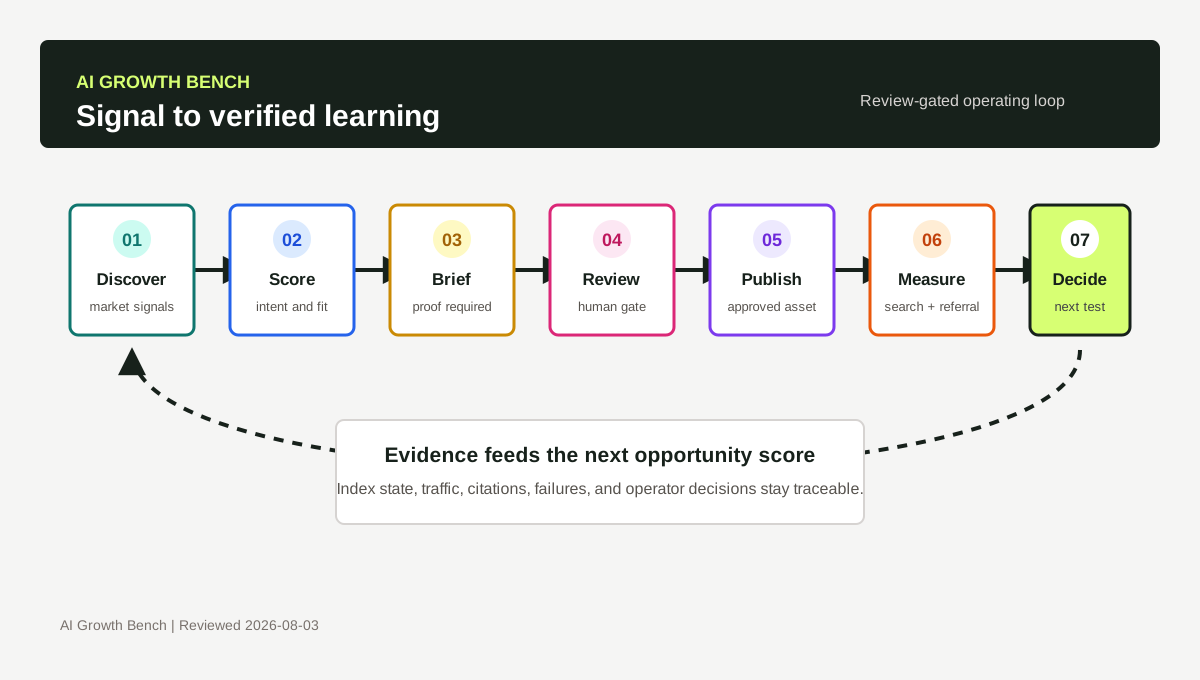
AI growth automation workflow from signal discovery through scoring, review, publishing, measurement, and weekly decisions
The operating loop keeps human gates before publication and feeds verified outcomes back into the next opportunity score.

What should an AI growth workflow automate?

Automate repeatable collection and transformation work: gathering approved signal sources, normalizing keywords, applying a transparent score, assembling briefs, checking required fields, drafting distribution copy, and updating reports. Keep the automation observable. Every output should retain its source, confidence, status, and next review date so an operator can trace how a market signal became a public experiment.

Where should human review remain?

Human review should control which opportunity deserves investment, which claims are supportable, whether the page adds distinct value, and whether publication creates reputational or search risk. The operator should also decide when weak pages are merged, held, or removed. These decisions depend on context and accountability, not only a model score.

How do you measure whether the workflow works?

Measure the complete handoff, not draft output. Track time from signal to approved page, gate rejection reasons, sitemap inclusion, crawl and index state, non-brand impressions, referral visits, useful actions, and answer-engine citations. A zero-result experiment is still evidence when the tested URL, date, prompt, source, and next decision are recorded clearly.

Current evidence gate

What is verified, pending, or still at baseline?

CheckDecisionEvidence
ScopePassThe bench limits this discovery test to three distinct operating playbooks instead of generating a broad keyword inventory.
Publish gatePassThe August 15 review verified the public crawl surface and found 19 of 23 inspected sitemap URLs indexed.
Google discoveryPassGoogle URL Inspection reported this child page submitted and indexed on August 15, resolving the August 3 discovery gap.
OutcomeBaselineThe site recorded 145 Search Console impressions and no clicks from July 18 through August 14; query and page demand remain the next measurement.

Workflow

  1. 01Collect signals from search suggestions, customer questions, community threads, competitor pages, answer engines, and internal support notes.
  2. 02Normalize each signal into a keyword, audience, page angle, source evidence, and confidence score.
  3. 03Score the opportunity by velocity, pain, conversion fit, competition gap, and whether the site can add a specific point of view.
  4. 04Create a page brief before drafting: target query, direct answer, proof requirements, internal links, distribution copy, and blocked claims.
  5. 05Generate the first draft only after the brief is clear, then run quality gates for thin content, duplicate angle, missing evidence, and weak next action.
  6. 06Publish only pages that pass the gate into sitemap, feeds, llms.txt, and internal navigation.
  7. 07Track index state, search visibility, referral clicks, answer-engine mentions, and manual observations in a weekly report.

Quick wins

  • Start with 3 to 5 high-intent playbook pages instead of 50 thin pages.
  • Add a direct 120 to 160 word answer near the top of every page so search engines and answer engines can quote the core point.
  • Put each new page into sitemap.xml, sitemap.txt, RSS, Atom, llms.txt, and at least two internal link blocks.
  • Write one LinkedIn post, one Reddit-safe discussion prompt, and one short X thread per page to create non-Google discovery.
  • Record what happened after publishing. Even zero clicks is useful if the page was indexed and got impressions.

Proof signals

  • The page has a clear target keyword and search intent.
  • The workflow is visible in the page body, not hidden in a private document.
  • The page links to system, reports, evidence log, and search discovery surfaces.
  • The site does not claim traffic or ranking until GSC, logs, or external search results show evidence.

Distribution angles

  • Share as a remote growth operations sample: 'Here is how I would wire AI into a growth workflow without turning it into content spam.'
  • Share as an SEO/GEO systems note: 'The useful automation is not writing. It is deciding what deserves to be written and proving what happened next.'
  • Share as a portfolio proof page when applying for remote SEO, content operations, or AI automation roles.

Official sources

Guidance used for this playbook.