Distinct intent
Pass: One audience problem and a purpose that is not already served by another URL.
Block: Only the keyword, location, product, or heading changes.
Programmatic SEO
This public bench connects page briefs, generated drafts, human quality gates, discovery state, and measured outcomes without hiding the operating decisions in a private admin panel.
Direct answer
Programmatic SEO is a system for creating useful pages from structured data and repeatable templates without treating every keyword variation as a page. A safe workflow starts with a real audience problem, groups related queries by intent, defines what information must be unique, and creates a page brief before generation. Each draft then passes gates for distinct purpose, original evidence, answer completeness, source quality, authorship, internal links, canonical metadata, and a measurement plan. Pages that only swap names or phrases should be merged, held, or excluded from the sitemap. Human review remains responsible for the publication decision and factual claims. After release, Search Console, analytics, crawl logs, and user actions determine whether a page should be improved, consolidated, or removed. The goal is not maximum URL volume; it is a maintainable set of pages that earns useful discovery and produces evidence for the next decision.
Reviewed by Alex on 2026-09-04. This implementation uses local structured records so the publication logic stays inspectable before any database or paid content API is added.
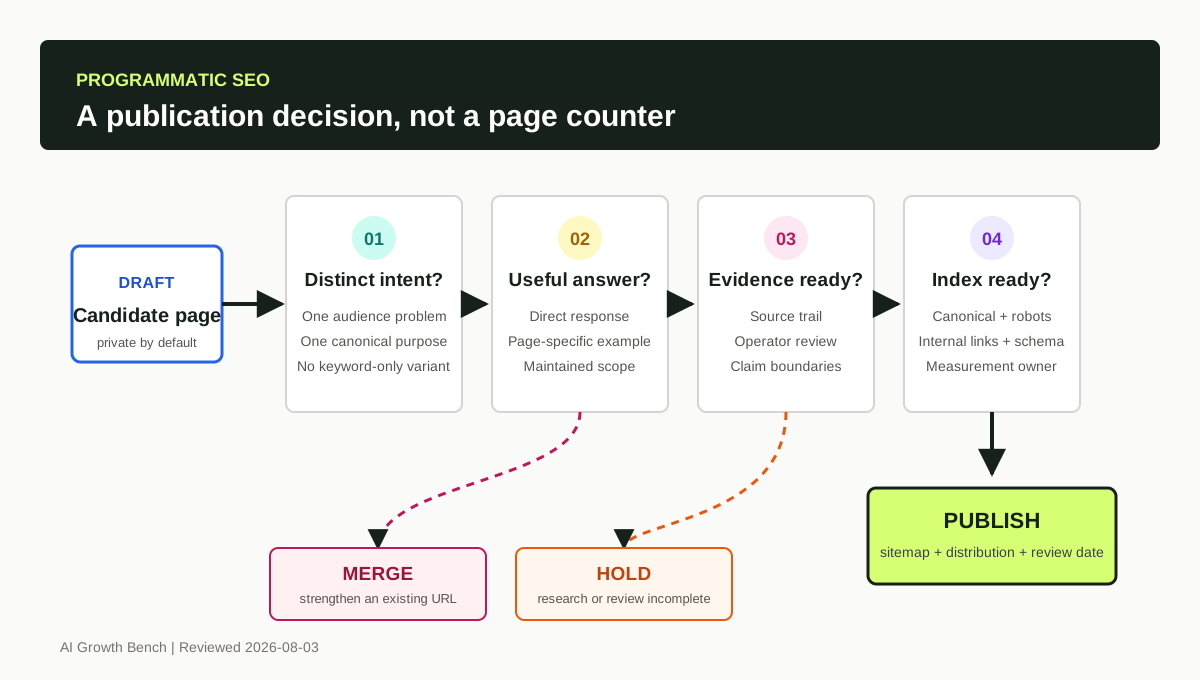
Publication gate
Pass: One audience problem and a purpose that is not already served by another URL.
Block: Only the keyword, location, product, or heading changes.
Pass: Page-specific evidence, example, calculation, workflow, comparison, or first-party observation.
Block: A stitched summary that adds no decision support beyond existing sources.
Pass: A direct answer is followed by enough detail for the reader to complete the intended task.
Block: The page repeats the query but forces the reader to search again.
Pass: Claims have sources, the reviewer is visible, and automation use is explainable.
Block: Unsupported claims, unclear authorship, or no correction path.
Pass: Self-canonical, indexable, internally linked, server-rendered, and intentionally included in feeds and sitemap.
Block: Orphaned, duplicated, blocked, or published only to increase URL count.
Pass: Named success metric, evidence source, next review date, and merge or removal rule.
Block: Publication is treated as the outcome and weak pages remain indefinitely.
Brief queued
1
Draft generated
0
Editorial review
0
Published
5
/what-is-ai-growth-bench
Dedicated entity-definition page with direct answer, FAQ, workflow, answer-engine baseline, and JSON-LD.
/case-studies/ai-trend-prompt-hub
External project case study separating AI Growth Bench portfolio positioning from the older AI Trend Prompt Hub site.
/geo-bench/geo-content-checklist
Published experiment page with question-led sections, extractable definitions, entity coverage, and source slots.
Open experiment page/programmatic-seo/ai-agent-workflow-audit
Published experiment page that demonstrates workflow diagnosis, quality gates, and distribution copy.
Open experiment page/playbooks/programmatic-seo-quality-gates
Consolidated canonical playbook for publication, merge, hold, and noindex decisions; the thinner experiment route redirects here.
/reports/ai-visibility-report-template
Promising intent, but evidence collection is not strong enough for publication yet.
Operating questions
Every page needs a distinct user problem, a self-contained answer, page-specific facts or examples, and a reason to exist separately from its parent or sibling pages. The template may stay consistent, but the information value cannot be a keyword substitution. When the unique section is too weak, the content belongs inside a stronger hub instead of a new URL.
Only after it passes content and technical review. The page should be public, self-canonical, internally linked, indexable, mobile-readable, source-backed, and owned by a named reviewer. It also needs a next measurement date. Sitemap inclusion helps discovery; it does not guarantee indexing, ranking, traffic, or AI citation.
Track the funnel from approved brief to published URL, crawl, indexing, impressions, clicks, useful sessions, conversions, and content maintenance decisions. Record rejected pages too. A strong system proves that quality gates prevented duplicate or unsupported pages, not only that automation produced a large inventory.
Primary sources
Use original analysis, clear authorship, first-hand experience, and a people-first purpose.
Scaled low-value content and doorway pages can violate search policies regardless of how they are produced.
Useful non-commodity content matters more than creating a separate page for every query variation.
Include canonical URLs the site actually wants surfaced; submission is a discovery signal, not a guarantee.
Current evidence
On 2026-08-15, Google URL Inspection showed the Traffic Playbooks hub and all three child playbooks indexed. AI Growth Bench recorded 145 Search Console impressions and no clicks in the reviewed 28-day window. The next decision depends on query fit, useful referrals, and citation evidence, not a larger batch of automatically generated URLs.