Traffic Playbook

GEO Visibility Audit Checklist

A checklist for reviewing whether a page is understandable, quotable, and verifiable enough for AI search and answer engines.

Direct answer

A GEO visibility audit is a structured review of whether an answer engine can access, understand, extract, verify, and attribute a page. It checks crawler access, server-rendered content, canonical identity, a concise answer near the top, question-led sections, consistent entities, visible authorship, current dates, primary sources, and evidence that distinguishes verified results from hypotheses. The audit should also repeat the same real-world prompts across ChatGPT search, Perplexity, Gemini, and Google AI features, recording whether the project is mentioned, whether a source URL is cited, and whether the answer is accurate. Passing the audit does not guarantee a citation. It means the page supplies enough clear and trustworthy material for a system to evaluate. The useful output is a dated evidence log with the tested URL, prompt, surface, observed citation, error, and next change, so visibility claims remain reproducible instead of promotional.

Reviewed by Alex, builder and operator of AI Growth Bench. Last reviewed 2026-08-15.

Target keyword

GEO visibility audit checklist

Search intent

Founders, SEO teams, and content operators want to know why AI answer engines do or do not mention their pages.

Last reviewed

2026-08-15

Google discovery

Submitted and indexed in the 2026-08-15 Google URL Inspection snapshot.

Why this matters

Many pages are written for a traditional search result but not for answer extraction. They bury the answer, use unclear entity names, skip proof, and do not explain who maintains the page. GEO work starts by making the page easier to parse, quote, and verify.
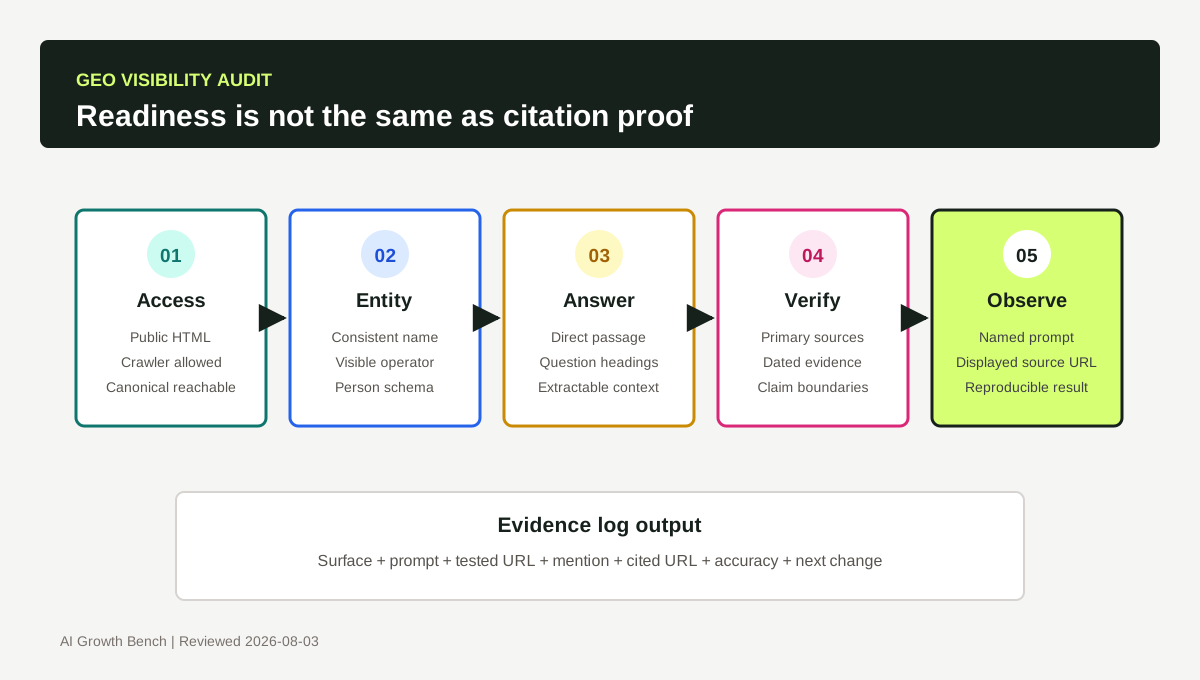
GEO visibility audit sequence covering access, entity clarity, answer extraction, source verification, and citation evidence
GEO readiness and verified citation are separate states; the audit records each transition instead of treating crawler access as visibility proof.

What does a GEO visibility audit measure?

It measures five separate conditions: technical access, entity clarity, extractable answers, verifiable evidence, and observed answer-engine outcomes. Keeping those conditions separate prevents a crawlable page from being described as cited, and prevents a model mention from being described as a sourced recommendation when no URL was actually shown.

How do AI search crawlers discover the page?

Discovery depends on normal web signals such as public links, crawlable HTML, robots rules, and participating search indexes. OpenAI asks publishers not to block OAI-SearchBot for ChatGPT search inclusion, while Perplexity documents PerplexityBot for search results. Access permits evaluation; it does not promise selection or citation.

What counts as verified AI visibility?

Verified visibility requires a dated observation from a named surface and prompt. Record whether the answer mentioned the entity, linked or cited the tested canonical URL, represented the page accurately, and remained reproducible in a follow-up run. A crawler hit, an llms.txt file, or a high readiness score is supporting evidence, not proof of citation.

Current evidence gate

What is verified, pending, or still at baseline?

CheckDecisionEvidence
Crawler accessPassThe public robots policy allows OAI-SearchBot, GPTBot, ChatGPT-User, PerplexityBot, ClaudeBot, and major search crawlers.
Entity clarityPassAI Growth Bench is consistently identified as Alex's personal portfolio project through visible copy, canonical URLs, Person schema, and llms.txt.
Google discoveryPassGoogle URL Inspection reported the GEO playbook child URL submitted and indexed on August 15. Citation evidence remains a separate pending state.
AI citationPendingNo new citation claim is published until a named answer engine returns and displays the canonical source URL for a repeated prompt.

Workflow

  1. 01Check whether the target entity is named clearly in the title, H1, intro, schema, and internal links.
  2. 02Add a short direct answer that can stand alone without surrounding context.
  3. 03Use question-led H2 or H3 sections for the exact prompts a buyer, researcher, or answer engine may ask.
  4. 04Show proof boundaries: what is verified, what is pending, what is a hypothesis, and what should be tested next.
  5. 05Allow major AI search crawlers in robots.txt and provide llms.txt with canonical URLs and facts.
  6. 06Record manual checks from ChatGPT, Perplexity, Gemini, Grok, and Google AI Overview when possible.
  7. 07Update the page when the answer-engine result changes, not just when the page design changes.

Quick wins

  • Add one definition page for the project, product, person, or service.
  • Make sure the definition page is linked from the homepage, about page, sitemap, feeds, and llms.txt.
  • Create one evidence log that answer engines and human reviewers can use to verify claims.
  • Test the exact same prompt across answer engines and record whether they mention, cite, or misunderstand the site.
  • Do not claim AI visibility until a screenshot, citation, or reliable observation exists.

Proof signals

  • The page has a direct answer in the first viewport.
  • The entity is consistent across title, H1, schema, llms.txt, and internal links.
  • Robots.txt allows major AI search crawlers.
  • The site records pending and failed answer-engine tests instead of hiding them.

Distribution angles

  • Share as a GEO readiness checklist for founders and SEO teams.
  • Use it as a public audit sample before pitching AI search visibility work.
  • Turn the checklist into a short social post: 'Most AI search misses are not model problems. They are entity and evidence problems.'

Official sources

Guidance used for this playbook.